I've been thinking a lot about thanksgiving this past week, both for a class I recently taught (see post bel0w) and for a Thanksgiving Eve celebration we're planning for tomorrow night at LO. As I've been looking around, I discovered this Litany of Thanksgiving in the Book of Common Worship. I think it's a wonderful prayer....
Give thanks to the Lord who is good.
God's love is everlasting.
Come, let us praise God joyfully.
Let us come to God with thanksgiving.
For the good world;
for things great and small, beautiful and awesome;
for seen and unseen splendors;
Thank you, God.
For human life;
for talking and moving and thinking together;
for common hopes and hardships shared from birth until our dying;
Thank you, God.
For work to do and strength to work;
for the comradeship of labor;
for exchanges of good humor and encouragement;
Thank you, God.
For marriage;
for the mystery and joy of flesh made one;
for mutual forgiveness and burdens shared;
for secrets kept in love;
Thank you, God.
For family;
for living together and eating together;
for family amusements and family pleasures;
Thank you, God.
For children;
for their energy and curiosity;
for their brave play and startling frankness;
for their sudden sympathies;
Thank you, God.
For the young;
for their high hopes;
for their irreverence toward worn-out values;
for their search for freedom;
for their solemn vows;
Thank you, God.
For growing up and growing old;
for wisdom deepened by experience;
for rest in leisure;
and for time made precious by its passing;
Thank you, God.
For your help in times of doubt and sorrow;
for healing our diseases;
for preserving us in temptation and danger;
Thank you, God.
For the church into which we have been called;
for the good news we receive by Word and Sacrament;
for our life together in the Lord;
We praise you, God.
For your Holy Spirit;
who guides our steps and brings us gifts f faith and love;
who prays in us and prompts our grateful worship;
We praise you, God.
Above all, O God, for your Son Jesus Christ,
who lived and died and lives again for our salvation;
for our hope in him; and for the joy of serving him;
We thank and praise you, Eternal God,
for all your goodness to us.
Give thanks to the Lord, who is good.
God's love is everlasting.

Showing posts with label Liturgical Year. Show all posts
Showing posts with label Liturgical Year. Show all posts
Tuesday, November 20, 2007


Tuesday, April 10, 2007
The Paschal Homily of St. John Chrysostom (349-407)
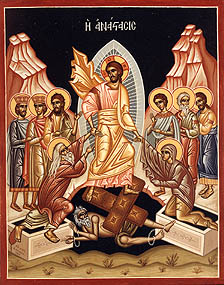 Is there anyone who is a devout lover of God?
Let them enjoy this beautiful bright festival!
Is there anyone who is a grateful servant?
Let them rejoice and enter into the joy of their Lord!
Are there any weary with fasting?
Let them now receive their wages!
If any have toiled from the first hour,
let them receive their due reward;
If any have come after the third hour,
let him with gratitude join in the Feast!
And he that arrived after the sixth hour,
let him not doubt; for he too shall sustain no loss.
And if any delayed until the ninth hour,
let him not hesitate; but let him come too.
And he who arrived only at the eleventh hour,
let him not be afraid by reason of his delay.
For the Lord is gracious and receives the last even as the first.
He gives rest to him that comes at the eleventh hour,
as well as to him that toiled from the first.
To this one He gives, and upon another He bestows.
He accepts the works as He greets the endeavor.
The deed He honors and the intention He commends.
Let us all enter into the joy of the Lord!
First and last alike receive your reward;
rich and poor, rejoice together!
Sober and slothful, celebrate the day!
 You that have kept the fast, and you that have not,
rejoice today for the Table is richly laden!
Feast royally on it, the calf is a fatted one.
Let no one go away hungry. Partake, all, of the cup of faith.
Enjoy all the riches of His goodness!
Let no one grieve at his poverty,
for the universal kingdom has been revealed.
Let no one mourn that he has fallen again and again;
for forgiveness has risen from the grave.
Let no one fear death, for the Death of our Savior has set us free.
He has destroyed it by enduring it.
He destroyed Hades when He descended into it.
He put it into an uproar even as it tasted of His flesh.
Isaiah foretold this when he said,
"You, O Hell, have been troubled by encountering Him below."
Hell was in an uproar because it was done away with.
It was in an uproar because it is mocked.
It was in an uproar, for it is destroyed.
It is in an uproar, for it is annihilated.
It is in an uproar, for it is now made captive.
Hell took a body, and discovered God.
It took earth, and encountered Heaven.
It took what it saw, and was overcome by what it did not see.
O death, where is thy sting?
O Hades, where is thy victory?
Christ is Risen, and you, o death, are annihilated!
Christ is Risen, and the evil ones are cast down!
Christ is Risen, and the angels rejoice!
Christ is Risen, and life is liberated!
Christ is Risen, and the tomb is emptied of its dead;
for Christ having risen from the dead,
is become the first-fruits of those who have fallen asleep.
To Him be Glory and Power forever and ever. Amen!

Friday, March 09, 2007
Lent and the Love of God
“Fear nothing and never be afraid; and don’t fret. If only your penitence fail not, God will forgive all. There is no sin, and there can be no sin on all the earth, which the Lord will not forgive to the truly repentant! Man cannot commit a sin so great as to exhaust the infinite love of God. Can there be a sin that would exceed the love of God?
“Think only of repentance, continual repentance, but dismiss fear altogether. Believe that God loves you as you cannot conceive; that he loves you with your sin, in your sin. It has been said of old that over one repentant sinner there is more joy in heaven than over ten righteous men.
“Now go, and fear not. Be not bitter against men. Be not angry if you are wronged. Forgive the dead man in your heart what wrong he did you. Be reconciled with him in truth. If you are penitent, you love. And if you love, you are of God. All things are atoned for, all things are saved by love.
If I, a sinner even as you are, am tender with you and have pity on you, how much more will God. Love is such a priceless treasure that you can redeem the whole world by it, and expiate not only your own sins but the sins of others.”
- from Dostoevsky, The Brothers Karamazov
We are all wired differently. We engage the spiritual life, the life of faith, in different ways. Some of us thrive on solitude, silence, and prayer, while others long for the boisterous clamor of fellowship or the emotive power of rich worship. Some crave the intense, intentional study of the Word, while others are filled with life by emptying themselves for the sake of others in service. Now, ideally we will find ourselves moving into fluidly between each of these spheres, as we see modeled in the life of Jesus, but most of us have a tendency to gravitate naturally to one or another. That is one of the reasons that we need community. We need to be in relationship with those who thrive on different aspects of the spiritual life because it will help all of us be more holistic in our faith; we need others like ourselves to remind us that we are not alone, to encourage us on the journey of faith.
That is one reason that I am so thankful that many in the Churches of Christ are (re)discovering the beauty of the Christian calendar. Growing up I remember listening to people preach about the resurrection at Christmas and about the birth of Christ on Easter Sunday. It was always a little strange to me, out of place, like eating turkey and dressing on the Fourth of July. Even then, at that early age, there was something inside of me, something about my wiring, that needed the natural movement of the Christian calendar to help make sense of the seasons of my spiritual journey. I am neither smart enough nor disciplined enough to live into all of the depth and beauty of the Christian life each and every day. I needed the ebbs and flows of the Christian year as a vital part of my spirituality to help me on my journey. I need the birth of Christ at Christmas after the season of anticipation called Advent, the resurrection on Easter after the season of fasting, repentance, and preparation called Lent.
This week we find ourselves right in the middle of the season many Christians call Lent. While for many of us this may just bring up memories of “fishy Fridays” in our elementary school cafeterias, Lent is much more than that. Lent is a season of personal and corporate reflection and introspection, of repentance and confession. (This is important in a tradition like ours that has often minimized “confession” to be a statement of our belief in Jesus before baptism.) It is a time of restoration, during which we our refocus our vision of Christ as the model for our own lives. It is a time of solidarity, where we seek to refocus our vision for the “least of these.” So, during this time we reflect on God’s work in the world, on Christ’s cruciform (cross-shaped) life and mission, and we reflect on how our own spiritual journey can grow more into a reflection of his life in the world.
From very early in the history of the church, Lent developed as a season of introspection and repentance for those who were studying and preparing for baptism. The early church understood the deep commitment that came with baptism, and they did not want anyone to enter the baptismal waters lightly or haphazardly, so this season of fasting and commitment was vital to those who were counting the cost of taking up their cross and following Jesus. It was also a time when the baptized community looked deep within their own hearts to consider their own lives, their commitment to and their failings in answering the call of Christ. All of this led to the renewal of their baptismal commitments during the celebration of Easter, a recommitting of their lives to the way of Jesus.
That is why this forty day season is so important to me. This is a time of deep reflection and introspection for me. It is a time of confession and repentance. It is a time during which I try to commit myself to dying to sin, to seeking the way of the cross, to hungering and thirsting for God, to living for the sake of others. It is a time of preparation for me, when I set my mind to reconsidering the intense and all encompassing claims of my baptism on my life and prepare to recommit myself again to walking in the way of Jesus.
I guess that is one reason that I love Dostoevsky’s words on the deep wells of the love of God that exceed all of my sin and failings. As I live in “continual repentance” for these forty days of Lent, his words serve as an empowering reminder: “Fear nothing and never be afraid; and don’t fret. If only your penitence fail not, God will forgive all. There is no sin, and there can be no sin on all the earth, which the Lord will not forgive to the truly repentant! Man cannot commit a sin so great as to exhaust the infinite love of God. Can there be a sin that would exceed the love of God? Think only of repentance, continual repentance, but dismiss fear altogether. Believe that God loves you as you cannot conceive.”
Thursday, March 01, 2007
Merton & Lent
The Lenten season always seems to drive me back to my good friend Thomas Merton. Maybe its the deep introspection and contemplation of the mysteries of life and God. Merton did write a book called New Seeds of Contemplation, so it seems only fitting.
Here are a couple of quotes that I love from New Seeds that really strike me, especially during this time of year:
Here are a couple of quotes that I love from New Seeds that really strike me, especially during this time of year:
Our vocation is not simply to be, but to work together with God in the creation of our own life, our own identity, our own destiny. We are free beings and sons [and daughters] of God. This means to say that we should not passively exist, but actively participate in His creative freedom, in our lives, and in the lives of others, by choosing the truth. To put it better, we are even called to share with God the work of creating the truth of our identity. (32)
Be content that you are not yet a saint, even though you realize that the only thing worth living for is sanctity. Then you will be satisfied to let God lead you to sanctity by paths that you cannot understand. (59-60)
Sunday, February 18, 2007
Transfiguration and the Lenten Season
Today is Transfiguration Sunday. The texts for today are majestic in their story, movement, and sweep: Exodus 24:29-35, Psalm 99, Luke 9:28-36, and 2 Corinthians 3:12-4:2. These texts are brilliant because they do more than remind us of the power of the transformative brilliance of God on the lives of those who encounter God. They serve as a doorway into the Lenten season, a season of repentance, of cleansing, of metamorphosis. Today we are given the glorious hope that we have a place in our story, that, like the narratives of Moses and Jesus, we too are "being transformed into the same image from one degree of glory to another." Of course, with that insight comes the reminder and realization that we have not arrived, we are not complete on this journey. Opportunities and, better, demands for growth abound. Repentance is not optional, but necessary. This life of faith, this personal and inner-transfiguration in the lives of believers demands a renewed conviction, a recommitment to following the way of Jesus up to the cross. So, this week we once again make the yearly turn from Transfiguration Sunday to Ash Wednesday to begin the journey with Jesus from glory ("It's good for us to be here.") to cross ("It is complete.").
As I think about the Lenten season, I am reminded of my own lack of commitment to prayer. I struggle with prayer, because I have little use for most of the "Christian" prayer that I hear. More often than not it seems to be an attempt to cajole God to provide a laundry list of things that we want, much like a birthday list. I know that there is a place for such lists, but I worry that the way we have been taught to pray these lists have deeper roots in our consumer culture than in the Christian worldview. (I admit that it's my cynicism talking here.)
The type of prayer that resonates with me is prayer that is forged in silence and simplicity. It is painful prayer, for it forces me to face my own inadequacy, my own weakness, my own failing in the face, especially when I find myself coming before the presence of the Holy Wholly Other. But in my busy world (a business that simply protects my own need to feel relevant and shields me from time for this kind of prayer) I have little space to cultivate this kind of prayer life.
So, one of my commitments this Lenten season is to rediscover prayer. I am going to start with a good old friend, the Jesus Prayer. It is a simple prayer, widely practiced in the EO tradition, that can be prayed rhythmically with your breathing. The repetitive and rhythmic nature of the prayer draws you into deeper contemplation. (In that way, it is very similar to the meditative, prayerful flow of a Taize' hymn.)
"Lord Jesus Christ, Son of the Living God, have mercy on me."
To round out the Trinitarian focus of my prayer life, I plan to add two similar prayers I discovered in N.T. Wright's Simply Christian.
As I think about the Lenten season, I am reminded of my own lack of commitment to prayer. I struggle with prayer, because I have little use for most of the "Christian" prayer that I hear. More often than not it seems to be an attempt to cajole God to provide a laundry list of things that we want, much like a birthday list. I know that there is a place for such lists, but I worry that the way we have been taught to pray these lists have deeper roots in our consumer culture than in the Christian worldview. (I admit that it's my cynicism talking here.)
The type of prayer that resonates with me is prayer that is forged in silence and simplicity. It is painful prayer, for it forces me to face my own inadequacy, my own weakness, my own failing in the face, especially when I find myself coming before the presence of the Holy Wholly Other. But in my busy world (a business that simply protects my own need to feel relevant and shields me from time for this kind of prayer) I have little space to cultivate this kind of prayer life.
So, one of my commitments this Lenten season is to rediscover prayer. I am going to start with a good old friend, the Jesus Prayer. It is a simple prayer, widely practiced in the EO tradition, that can be prayed rhythmically with your breathing. The repetitive and rhythmic nature of the prayer draws you into deeper contemplation. (In that way, it is very similar to the meditative, prayerful flow of a Taize' hymn.)
"Lord Jesus Christ, Son of the Living God, have mercy on me."
To round out the Trinitarian focus of my prayer life, I plan to add two similar prayers I discovered in N.T. Wright's Simply Christian.
"Father Almighty, maker of heaven and earth, set up your kingdom in our midst."
"Holy Spirit, breath of the living God, renew me and all the world."
and
"Holy Spirit, breath of the living God, renew me and all the world."
Subscribe to:
Posts (Atom)